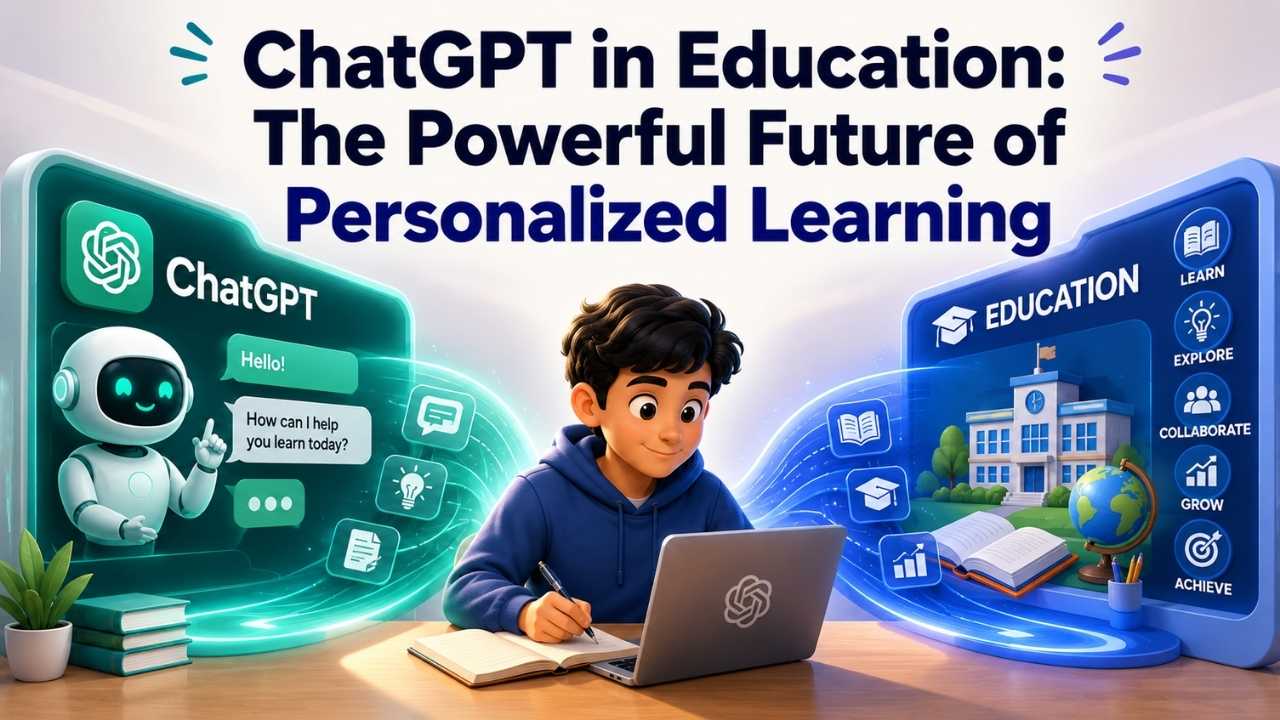
ChatGPT in Education is changing how students learn and how teachers teach, and I mean, it honestly couldn’t have come at a better moment. You know that feeling, like being in a classroom with 60 people, trying to wrap your head around a tricky concept, but kind of stuck, afraid to raise your hand, like no one else is wondering, right Or staying up past midnight before an exam, wishing someone could just explain that one difficult topic one more time in your own language?
That struggle is real — and millions of students across India face it every single day.
Here is the good news. Whether you are a Class 10 student preparing for board exams, a college student working on a research project, or a teacher trying to make lessons more engaging—AI is now your smartest study partner.
This article will walk you through everything you need to know about the use of ChatGPT in Education — the benefits, the tools, the challenges, and what the future holds.
Table of Contents
What is ChatGPT in Education?
ChatGPT is kind of an artificial intelligence tool that was made by OpenAI, and it’s able to read what you ask, and then it can explain ideas. It can write essays too, summarise topics and even run a full conversation with you in just seconds.
When people talk about ChatGPT in Education , what they usually mean is using it as a support for learning and also for teaching, research, and other academic growth. It’s like this very sharp tutor that’s basically ready 24/7, you know, seven days a week… and in many cases it’s free, or at least it has a very low cost.
Unlike a search engine that just tosses you links, ChatGPT gives you straight-up answers. It flexes based on your level, so it kind of feels right instead of generic. You can tell it to explain a topic “like I’m in Class 8” or “at a college level”, and it will tune itself accordingly.
Why ChatGPT is Changing Modern Education
Traditional learning kind of follows this one-size-fits-all thing. A teacher goes ahead and teaches the same lesson to 40 students—even if each one processes information differently. And that’s where AI for education sort of shows up.
ChatGPT helps make learning personal, not just generic. It talks to you in the way you need, at your pace. You can ask the same question five times, but in five slightly different forms, and it doesn’t get annoyed. For learners in tier-2 and tier-3 cities in India, where getting a really good tutor is limited, this can be genuinely life-changing.
Coaching places like those around Kota or Delhi are now seeing students using ChatGPT not just for homework but as a quick extra layer to what they learn in class. Online platforms such as BYJU’S and Unacademy are also bringing in AI tools to tune the pace and path for each learner—like really tailoring the whole studying arc. So yeah the change is legit, and it’s unfolding right now, not some future plan.
Key Benefits of ChatGPT in Education
The benefits of ChatGPT in Education really go way farther than just answering questions, honestly. Here’s a quick rundown of it, because it can help in lots of small ways and also bigger ones too, depending.
1 Personalized Learning at Your Own Pace
Personalized learning is a major advantage, honestly. ChatGPT seems to adjust to what you understand, rather than pushing you along. If you are quick, it keeps going; if you are slower, it still follows you , with patience. There is no judgement, no pressure; it just works at your speed.
2. Available 24/7
Unlike a teacher or tutor, ChatGPT never sleeps. Late-night doubt before exams? No problem.
3. Multilingual Support
ChatGPT can explain topics in Hindi, Tamil, Bengali, and several other Indian languages — making it accessible for students who are not comfortable in English.
4. Instant Feedback and Explanations
Students get real-time answers. No waiting. No scheduling. This reduces learning gaps significantly.
5. Helps with Research
For college students, the research about ChatGPT in Education shows it significantly reduces the time spent finding information – while also improving the quality of academic work when used responsibly.
6. Makes Learning Interesting
Interactive, conversational explanations are far more engaging than textbook reading. Students stay curious longer.
How Students Can Use ChatGPT for Better Learning
A student in a government school in Bihar can now get the same sort of clarity of explanation as a private school kid in Mumbai gets. It’s like the whole thing is quieter yet more sharp, and yeah, that’s the power of AI in education, really.
How Teachers Can Use ChatGPT in the Classroom
ChatGPT for teachers is kind of equally powerful, as in it helps a lot. Teachers in India are already using it to save time and teach in a more effective way, even when the day feels super busy or messy.
ChatGPT Education License and Educational Discounts
Many educational institutions wonder about pricing. Here is what you need to know.
OpenAI offers a ChatGPT in Education License for schools, colleges, and universities. This is typically the ChatGPT Edu plan — designed specifically for academic use. It gives institutions access to advanced models, stronger data privacy, and management tools for teachers and students.
The ChatGPT education discount is available for verified academic institutions.
Schools and universities can reach out to OpenAI directly to look at bulk pricing and institutional plans and such. I mean a few Indian universities and IITs are already in conversation about using those packages.
For individual teachers, there is the usual ChatGPT Plus option (right now about ₹1,650 per month), and it gives access to the more powerful GPT-4 model, with snappier replies and improved precision.
ChatGPT for Students: Free vs Paid Options
One of the most commonly asked questions is — is ChatGPT free for students?’
Yes! ChatGPT for students free access is available through the basic ChatGPT plan at chat.openai.com. You simply create an account and start using it. The free version uses GPT-3.5, which is powerful enough for most student needs — essay help, concept explanations, exam prep, and more.
Here is a quick comparison:
Research About ChatGPT in Education
The research about ChatGPT in Education is growing rapidly. Here is what studies are showing:
The overall finding is pretty clear , you know: when it’s used responsibly, ChatGPT really improves learning outcomes in a noticeable way , it helps lower the achievement gap as well, and it also supports both students and teachers , like, in practice .
Challenges and Limitations of Using ChatGPT in Education
Sure, nothing is totally perfect. Using ChatGPT in education also brings its own issues, not just the good stuff, ya know… like it can help, but it also has downsides:
Academic Dishonesty
Some students end up using ChatGPT to just finish assignments, without really learning. That kind of defeats the whole idea, and it hurts long-term growth, skillwise.
Misinformation Risk
Sometimes ChatGPT gives answers that are not fully correct — especially with super new events or very niche, technical subjects. So please verify any important detail from dependable sources every time.
Digital Divide
Not every student in India has a smartphone or stable internet. Students from rural areas or lower-income families may still struggle to even reach these tools consistently.
Over-Dependence
If learners lean on AI too much, it can weaken critical thinking and problem-solving abilities, mostly when it’s used like a shortcut, not like a learning companion.
Privacy Concerns
Students should be cautious about sending personal details or sensitive information into any AI tool.
Best Practices for Using ChatGPT Responsibly
Here are some basic guidelines for both students and teachers, i mean really simple ones that you can keep in mind:
Future of Personalized Learning with AI
The future of AI in Education is closer than most people think. Here is what is coming:
Personalized learning will no longer be a luxury for students who can afford private tutors. It will be a right for every student — from Ladakh to Lakshadweep.
Why Educational Institutions Should Adopt ChatGPT
ChatGPT is pretty important in Education, not only for single learners you know. But schools, colleges, and coaching centres can benefit too, in ways that are more connected than people think.
Conclusion
We are standing at a turning point in how humans learn, kind of honestly. ChatGPT in Education is not just a trend — it is a real shift. From a Class 5 student in a small town to a postgraduate researcher at a national university, AI is opening doors that were previously closed and sort of out of reach.
Sure, there are challenges too. Sure, responsible use matters a lot. But the possibilities of ChatGPT in Education to make learning that is quality, personal, and interesting for every single student in India—yeah, that possibility is enormous.
So the question is not “will AI change education?” because it already is. The real question is are you ready to learn with it?
faq
1. Is ChatGPT free for students?
Ans. Yes, ChatGPT has a free plan, and it’s generally fit for most learning needs.
2. What are the good things about ChatGPT in education?
Ans. It gives quick assistance, kind of tailored practice and multilingual support, and it’s available 24/7, so whenever you need it.
3. Can teachers use ChatGPT in the classroom?
Ans. Yeah, teachers can use it to make lesson plans, craft quick quizzes, prep study materials, and even gather classroom resources, kinda fast, I guess.
4. What is the future of AI in Education?
Ans. AI will likely push personalized learning, provide more responsive tutoring support and open up educational access for a wider group of learners; basically, more people can get in.
5. Is ChatGPT safe for educational use?
Ans. Yes, it is generally safe, but only if it’s used responsibly. Students should double-check the facts, and not share personal data, like names, places or any kind of private details, ok
If you want to get service to edit your Google Business Profile professionally, then you can contact Gudsoft Academy on WhatsApp.