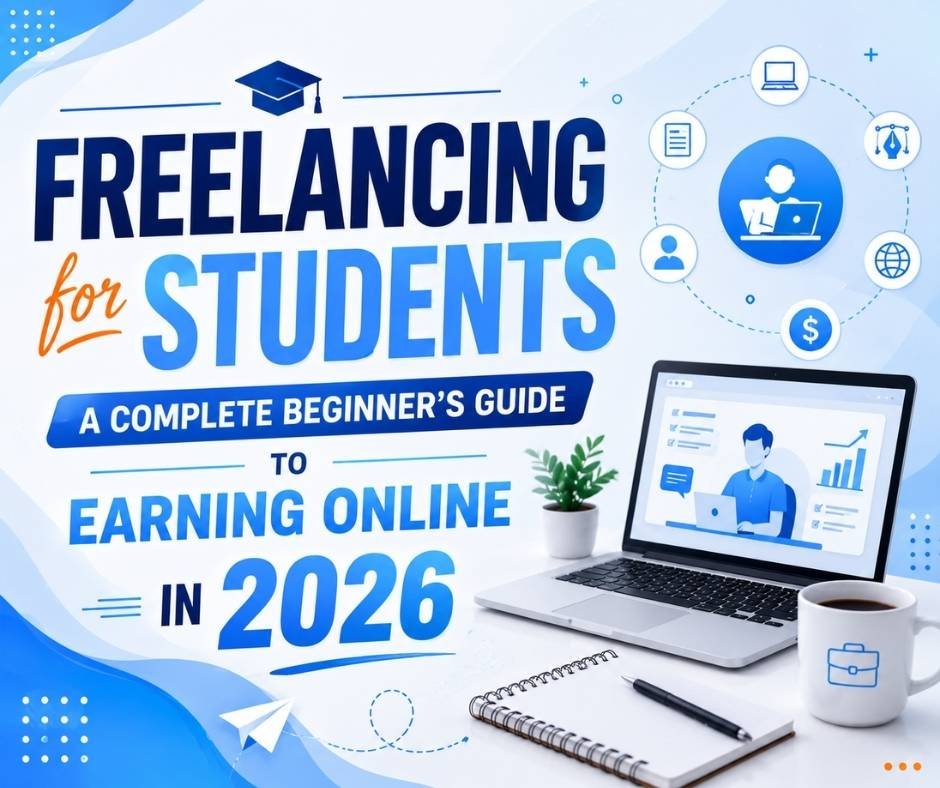
Freelancing for Students is kind of a easy method to make money, pick up real, hands-on know how, and get better at useful skills while you are studying. Most students can work online on projects such as content writing , graphic design , video editing, SEO, or social media management.
You do not really need years of experience to start either. Just one solid skill, some steady practice, and a basic portfolio , then you can slowly connect with clients and grow your experience over time. In this guide, you will see how to jump into freelancing, reach your first client, and keep freelance tasks in step with your studies.
What Is Freelancing?
Freelancing is basically working on your own, for clients or companies , instead of being stuck with one employer all the time. In many cases, a freelancer provides a particular service and then gets paid for single tasks, or for the work that’s agreed, even if it’s project based.
For example, a business can hire a freelance graphic designer, to make a set of Instagram posts—say ten pieces. After the assignment is finished , as described in the agreement, the freelancer gets paid.
This kind of freelancing makes it kinda different from a traditional part-time job. You can often pick the projects you want to do , work with a mix of different clients and kinda manage your time based on your availability.
For Freelancing for Students, this flexibility is one of the biggest advantages it kind of matters a lot. Students can work after classes, on weekends, or whenever their academic schedule allows it really depends.
Why Is Freelancing Good for Students?
Freelancing can offer benefits beyond earning money. It can also help students develop skills that may be useful after graduation.
Some important benefits include:
- Flexible working hours: Students can sorta choose tasks that fit around their study schedule
- Real-world experience: Freelance projects bring students right into actual client needs, not just theory
- Skill development: People can sharpen their abilities like writing, designing, SEO, marketing, or video editing as time goes on
- Portfolio building: Once those gigs are done, the results can turn into real evidence of what you can do
- Professional confidence: Talking to clients teaches how professional work really happens , day to day
- Different opportunities: Freelancers often end up working with customers from various industries and locations , which is pretty useful
Imagine a student studying digital marketing who manages social media for a small restaurant. Along with earning from the project, the student learns about content planning, customer behaviour, deadlines, and client communication. That experience can later strengthen their resume.
Best Freelancing Skills for Students in 2026
Picking just one practical skill is sort of better, than trying to learn everything at once , you know. Usually the best choice comes from what actually holds your interest, and also how much time you can spend studying, day by day.
Here are some beginner-friendly options:
Content Writing
Students who enjoy writing can offer blog writing, website content, product descriptions, or social media captions.
Graphic Designing
Basic graphic design is kind of useful, like for social media posts, banners , presentations , thumbnails , and promotional creatives, you know. Tools such as Canva can help beginners start practising , it makes the whole thing feel less heavy at first.
Social Media Management
A lot of small businesses really need a hand, with creating posts, mapping out content, answering messages, and keeping up their social media vibe going. It’s kinda like they’re juggling a few things at once, and it would be easier if somebody could manage those little tasks day to day, instead of them trying to do it all themselves.
Video Editing
Short form videos and promo reels kinda created a demand for editing video, and video editing. Beginners can start by getting down the basics like cuts, captions, transitions, and the whole storytelling vibe. You know just start there, don’t overthink it at first.
SEO
If you are a student and you look into digital marketing, you can pick up keyword research, on-page SEO, content optimisation kind of stuff, and also the fundamentals of local SEO.
Web Design
Students who have any real interest in tech can learn the basic web design stuff and well, create simple websites for people or, for small businesses too. It’s kind of a practical way to start, even if you are not fully sure yet.
Digital Marketing
Digital marketing is kinda about a bunch of moving pieces like SEO, social media marketing, content marketing, email marketing, and online advertising. You see these parts, together they work as a whole strategy, but sometimes people treat them like separate things.
Other options include virtual assistance, translation, presentation design, and basic data-related work.
The key point is not to pick a skill just because someone says it makes quick money, or something like that. Rather, choose that you truly are ready to work on and keep practising. If you’re not willing to practise it day by day, then it wont really fit you, you know.
How to Start Freelancing as a Student
If you are wondering how to start freelancing as a student , don’t make the whole process overly complicated. Just begin with one skill, then follow a simple path, like one careful step at a time.
Step 1: Choose One Skill
Start by thinking what service you actually want to provide. Like maybe content writing , or Canva design stuff, video editing, or that whole social media management thing. Just pick one direction, don’t overthink it at first. Once you have that in mind, the rest will be easier, sort of.
Step 2: Learn the Basics
Use free tutorials, courses, blogs and those practice resources too to grasp the basics, you know. Don’t just sit there waiting untill you know everything. Learn only enough, then start practising , immediately.
Step 3: Practise Regularly
Make your own projects, honestly. Like, if you are trying to be a graphic designer, then do some sample posts for an imaginary restaurant or even a coaching institute, just to see how it feels. And if you want to write, write sample blog entries too, don’t overthink it. Start small, go on from there…
Step 4: Create Sample Work
You need something that can show potential clients, like a little proof of work. Try to make three, maybe four or five good samples, that kinda demonstrate what you can do in practice.
Step 5: Build a Portfolio
Try to put your best samples into a kind of simple portfolio. You could use a personal website, a portfolio platform, or even a professional profile to show your work, basically, in a clear way.
Step 6: Create a Professional Profile
Create a clear profile describing your skill, services, and the type of clients you want to help. Use a professional photo and write a simple, honest introduction.
Step 7: Find Suitable Projects
Try to find projects that fit with what you can do right now, more or less. Don’t reach for the hard stuff yet, if you’re still working through the fundamental basics, bit by bit, because it can get messy fast.
Step 8: Send Personalised Proposals
Avoid sending exactly the same proposal to every client. take a look at the project requirements first, and then , in a brief but clear way , explain how i can contribute, and what parts i can handle more directly—like design work, debugging, or ongoing support, depending on what you actually need.
Step 9: Complete Your First Project Professionally
Communicate clearly, follow the instructions, keep to the deadline. Also, ask questions when something is not clear, even if you think it is obvious sometimes… or maybe not.
Step 10: Improve Your Profile
After completing genuine projects, add your best work to your portfolio and collect client feedback where appropriate.
This process may take time, but consistency matters more than trying to get a client on the first day.
Best Freelancing Websites for Students
Students can kind of wander through a few online platforms to spot freelance opportunities , it’s not always straight forward. Some common choices are Upwork, Fiverr, Freelancer, PeoplePerHour and LinkedIn, where you can also search around for gigs and project work.
Each platform works little different. Some are centered around project listings, while others kinda let freelancers advertise a single service type or specialty, which is nice.
For example, a beginner graphic designer might set up a service around social media post design. Meanwhile, a writer can provide blog writing, or website content , services.Students should read platform rules carefully, understand fees and payment conditions, and avoid clients who ask for suspicious payments or personal information.
LinkedIn can be really useful too , because it lets students set up professional connections and reach out to companies more directly, kind of without the usual formality. And it’s a good way to establish ties with people in the field.
Freelancing Jobs for Students
There are many freelancing jobs for students, depending on their skills.
Some examples include:
- Blog writing
- Social media post designing
- Canva designing
- Video editing
- SEO support
- Social media management
- Virtual assistant work
- Website content writing
- Presentation design
- Basic data-related tasks
Imagine a student who’s been using Canva. Instead of waiting around for some huge company, they can go to a nearby restaurant, coaching institute, salon, or even a small online business and say they would create social media designs for them, kind of as a trial run.
Better still, starting with small jobs helps a beginner grasp what clients actually expect before jumping into bigger assignments, because the little stuff is usually more confusing than people think.
How Much Can a Student Earn From Freelancing?
There is no fixed answer about how much a student can earn ,because it really depends. Freelancing income hinges on a few things like skill level, the sort of service, experience, portfolio quality, the number of clients you can pull in, how complex the projects are, and how well you can land steady work.
A beginner might initially earn less , since they’re still assembling experience and reviews, yknow. Once skills are sharper , work samples stronger , and clients come back more often, the chances to earn may go up, almost gradually.
Students should steer clear of anyone saying they can guarantee high income in just a few days. Freelancing is really a professional service, and money usually increases as the value you deliver improves.
The better question isn’t only “How much can I earn ?” , but also “What skill could I develop, that businesses are actually willing to pay for?” , like you know, something tangible in the real world.
Can You Start Freelancing Without Experience?
Yes, beginners can start Freelancing without experience, but they have to prove, not just “talk” , that they can deliver something genuinely helpful, even if it is small.
If you have never worked with a client before, then create sample projects. For example, a beginner content writer can build two or three original blog pieces. A designer can put together sample social media posts. A video editor can prepare a handful of short demo videos, just to show the result.
These samples dont have to come from actual clients, they are just showing what you can do right now, nothing more.
Start with smaller jobs, get feedback, then slowly move into harder tasks. Over time your portfolio can become more important than just stating that you are a beginner, it kinda does the talking for you.
How to Balance Freelancing and College Studies
Freelancing should help your progress, not wreck your study rhythm, you know.
Try to set clear working hours and stick to them, even if it feels a bit strict. Also don’t say yes to extra assignments beyond what you can genuinely wrap up. When exams come in, scale back your tasks instead of giving clients those impossible promises. In other words, keep your focus, bit by bit, and let your schedule stay calm.A simple routine could be:
- Classes and academic work first
- Freelancing during a fixed evening or weekend slot
- Regular breaks
- Clear project deadlines
- Extra time for unexpected revisions
If a client needs work pretty urgently and you’ve got an exam the next morning, it’s okay to say no ,really. Learning how to manage your availability is a very actual freelancing skill on its own ,sort of.
Common Mistakes Students Should Avoid
Beginners often make mistakes because they are excited to get their first project.
Try not to juggle five different skills at once. It’s usually smarter to become reasonably good at one particular service first, then go on from there .
Also, don’t automatically say yes to every project just because someone says they can pay. Take a moment to read the requirements, confirm the deadline, and think through the client expectations before you agree.
Avoid copying another freelancer’s portfolio or work. Your samples should be original.
Don’t share unneeded sensitive info with unknown clients, and just be a bit cautious about fake job offers, those suspicious payment requests, or recruiters who ask you to pay money first, before they actually give you work.
Like most important, do not let freelancing fully replace your education. Your studies still matter, even if it feels like the gigs are enough, yeah.
Tips to Get Your First Freelancing Client
Getting the first client is often the hardest part, but honestly it can be made simpler with a few practical strategies.
Start with one clear service, don’t sell the idea that you do everything, because people tend to trust focus more. Then create three to five solid portfolio samples, like real evidence not just claims. Also keep your profile professional and spell out, in a natural way, the specific issue you can help a client with, so it feels real and relevant, not vague.
Write a personalized proposal instead of copying the same message everywhere, you know, each time it should feel a little more direct and “made for them”, not like a template.
You can also use LinkedIn to connect with small businesses, startups, agencies, and professionals, and then reach out in a more thoughtful way. Local businesses are a pretty solid starting point since many of them often need assistance with social media, a website refresh, content that actually rings true, and general marketing support.
Focus on providing value rather than simply saying, “I need work.”
Freelancing vs Part-Time Job for Students
Both freelancing and traditional part-time jobs can be useful, but they work differently.
| Factor | Freelancing | Part-Time Job |
| Flexibility | Usually higher | Usually fixed |
| Working hours | Often self-managed | Generally scheduled |
| Skill development | Depends on projects | Depends on the role |
| Income | Project-based | Usually fixed or hourly |
| Location | Often remote | May require a workplace |
| Client | Can work with multiple clients | Can work with multiple clients |
A student who kinda likes hours that can flex might find freelancing, well, pretty enjoyable , though. On the other hand, someone who really prefers a fixed routine could feel more comfortable with a part-time job, instead. It’s not the same vibe, you know.
Why Learning Freelancing Skills Can Help Your Career
The value of freelancing is not limited to money.
Students learn how to talk with clients a bit more smoothly, sort out their needs , keep deadlines under control, fix unexpected issues and then show their work in a more professional way, so it makes sense to everyone and not just to them .
These skills can remain useful even if you later take a full-time job.
For example, a student that spends a year doing freelance digital marketing might end up graduating with both academic knowledge, and also real world practical experience. Their portfolio can likewise give employers something specific to look at.
That’s why Freelancing for Students can be seen as a learning chance along with an income option, sort of.
Conclusion
Starting freelancing for students dosent mean you just become an expert over night or anything like that. A more sensible way is to pick one skill, get the fundamentals down, practise steady, make a small portfolio, and then slowly reach out to potential clients. In other words it’s not instant, it’s more of a gradual climb.
Your first project may be small. Your first payment may also be small. That is completely normal.
What matters is building up experience step by step, while somehow keeping your education as the priority. With patience, useful know-how, professional communication, and steady effort, freelancing can turn into something valuable for your student path and, later on, your future career.
FAQs
- Is freelancing good for students?
Yes, freelancing can help students develop real-world capabilities, get experience, build a portfolio, and maybe earn some money while they’re studying. The thing is, the workload has to be kind of curated, so that your coursework stays the priority. If you don’t, everything can get messy.
- How can I start freelancing as a student?
Pick just one skill, learn the basics of it, then practise a bit by making sample projects. After that, build up a small portfolio, make a professional profile, and just start applying for projects that fit, especially the beginner-level ones.
- Which freelancing skill is best for students?
There isn’t one best skill for everybody, like it’s not a single key that fits all locks. Content writing, graphic design, video editing, SEO, social media management, web design, and digital marketing are a few options students can tinker with, depending on what they actually like, and what gives them a sort of spark.
- Can students start freelancing without experience?
Yeah, I mean students can make either personal or kind of sample projects to show what they can do. If they start with smaller projects first, they will get real, day to day practical experience and slowly build up a portfolio, so it doesn’t feel too heavy at the beginning.
- Which freelancing websites are best for students?
Students can go checking out platforms like Upwork, Fiverr, Freelancer, PeoplePerHour, and also LinkedIn, and kind of get a feel for how things work. They should really understand each platform’s rules ,and follow them, also stay awake to possible scams or sketchy deals that might happen.
- How much can a student earn from freelancing?
Income can swing a lot depending on the students skill, experience, the work they offer , how many clients they have , the scale of the project , and whether they stay steady. For a beginner there is no assured income figure, not really , it kind of depends.
If you want to get service to edit your Google Business Profile professionally, then you can contact Gudsoft Academy on WhatsApp.