Imagine two students with the exact same degree. One lands a solid job within a month, while the other kind of drifts and struggles for a year. So what’s the difference really? The Best Career Skills in 2026. In today’s competitive hiring market, employers don’t just stop at academic qualifications, they look past the diploma and into practical know-how that helps you handle real situations, solve problems ,and still deliver outcomes.
In 2026, the job market looks nothing like it did even five years ago, like, seriously. AI tools are doing tasks that used to take whole squads and a lot of time , and now it’s mostly handled, you know. Companies aren’t only hiring for degrees anymore, they’re hiring for what you can actually get done. That’s why understanding the best career skills in 2026 has suddenly become even more crucial than before, especially for students and fresh graduates trying to sort out where to put their effort.
The good news is you don’t need to be a genius, or spend lakhs on these fancy courses to build the skills. You just need to know which ones are actually useful, and start practicing them today. I mean let’s sort it out, step by step, really.
What Are Career Skills?
Career skills are basically those workable abilities that help you do well at a job , and also grow over time in it. They sort of land in two main groupings, technical skills on one side, and then soft skills, on the other, kind of a different vibe but still important.
Technical skills are basically those particular, teachable abilities like coding , data analysis , or even digital marketing. Soft skills meanwhile are more about the way you work with others and sort through situations, think communication, collaboration, and this general adaptability. They kinda go hand in hand but they’re not the same.
Here’s the truth: a degree tells an employer what you studied. Career skills tell them what you can contribute from day one. That’s a big difference in a competitive job market.
Why Career Skills Matter More Than Degrees in 2026
Employers today are far less impressed by a certificate and far more interested in real ability. Many companies now run practical tests or ask for project portfolios before even looking at your CGPA.
A big reason for this shift is AI and automation. Routine tasks — data entry, basic reporting, simple content writing — are increasingly handled by AI tools. This means human employees are expected to bring judgment, creativity, and skills that machines can’t easily replace.
The job market itself is changing shape too, kind of like it’s not standing still. Freelancing, remote work, and hybrid roles are growing really fast, and those setups tend to reward people who are self-driven and skilled , not merely those who have the right paperwork. Looking ahead, future career opportunities will probably lean more and more toward people who can mix technical know-how with solid interpersonal soft skills. That combination is uncommon , so it feels rare and honestly pretty valuable.
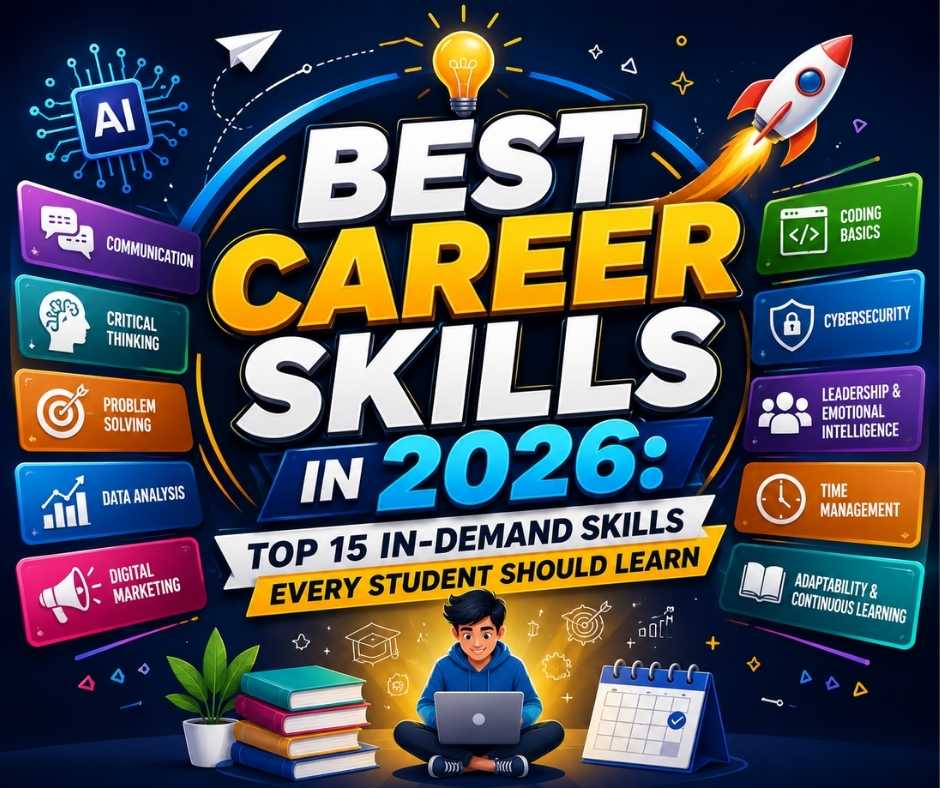
Top 15 Best Career Skills in 2026
Here’s a closer look at the skills that are shaping careers this year.
1. AI Literacy
Knowing how to use AI tools like ChatGPT, Claude, or Canva AI isn’t optional anymore it’s more or less expected. AI literacy is basically getting the hang of prompting AI in a solid way, double checking what it gives you, and then using it so you can work faster and with more calm. Students who pick this up early really do get an edge, because almost every industry nowadays uses some kind of AI in everyday operations.
2. Communication Skills
Being able to put your ideas across clearly, like in writing or speaking or even during presentations, is kinda one of those career skills that nobody really talks about enough. And sure, communication helps you stick out in interviews, keeps day to day work moving smoother with a team. It also helps you build real trust with clients, not just the polite kind. Basically it is a ability that pays off in every job, literally in every single one.
3. Critical Thinking
Critical thinking is basically the ability to analyze information, catch problems early, and take reasoned decisions not just go along with instructions blindly . In a world that’s kind of soaked with information ( and misinformation ) , employers usually want people who can think on their own, question things in a logical way, and not just accept whatever is presented.
4. Problem Solving
Every job kind of comes with these unexpected, sometimes awkward challenges, and you just end up leaning on problem-solving instincts so you can stay calm, sort out a tricky situation, and land on something practical instead of only guessing. In tech, business, and customer-facing roles this kind of ability is really valued too, because quick thinking makes a difference and yeah it can go sideways fast.
5. Digital Marketing
From SEO , all the way to social media ads, digital marketing skills are in huge demand because companies keep shifting online. Getting a feel for how to steer campaigns, inspect audience behavior , and craft engaging content can really open doors into marketing, sales, and even entrepreneurship.
6. Data Analysis
Data analysis skills help you kind of make sense of numbers and those trends, so you can guide decisions more clearly. You don’t have to be a full blown data scientist, not really, even basic know-how in Excel or Google Sheets, or a simple analytics tool will make you far more valuable in most any role.
7. Coding Basics
You do not need to be a full time developer, but having coding basics (Python, HTML) kind of helps you get a handle on how digital products work. It’s also a solid grounding, if later you want to shift toward tech, automation, or app creation.
8. Cybersecurity Awareness
As more work moves online, cybersecurity awareness has become essential — not just for IT professionals. Knowing how to spot phishing attempts, use strong passwords, and protect data is a skill every employee is expected to have.
9. Emotional Intelligence
Emotional intelligence kind of means you can notice and handle your own feelings, and also respond well to other people’s moods. It has a big role in teamwork, leadership , and in dealing with workplace stress, those are the things that AI really can’t mirror in the same way .
10. Project Management
Whether it’s a college assignment or a client deliverable, project management skills help you plan , organize and actually deliver the work on time, most of the time. Learning tools like Trello or Asana along with basic planning techniques makes you way more employable.
11. Financial Literacy
Understanding budgeting, saving, taxes, and investing isn’t just useful for personal life. It is, sort of, increasingly demanded in business roles too, even if people act like it is “extra”. Financial literacy tells employers you can think responsibly and make smart, informed choices, not just guess and hope.
12. Content Creation
With brands leaning hard on content, having the ability to write, edit video, or do graphic design becomes kinda a big deal. Stuff like content creation skills can open up chances in marketing, on social platforms, and yes even that side freelancing route, depending. And really, if you can craft posts, refine clips, or put visuals together in a clean way, you end up more useful than you might think.
13. Public Speaking
Confident public speaking helps in interviews, presentations, and leadership roles. Even basic training in this area — like joining a debate club or practicing presentations — can significantly boost your confidence and career growth.
14. Time Management
Time management is, kind of about picking which tasks matter most and spending your hours in a sensible way. In those really fast paced work settings, folks who can juggle deadlines well are often trusted with more significant duties sooner.
15. Adaptability & Continuous Learning
Maybe the biggest skill of all is that stubborn little willingness to keep learning, even when it feels slow. Because industries move fast, and the talent to adapt , like actually adapt— to snag new tools , pick up new processes, and swap in new ways of thinking— that is what keeps your career future proof.
Soft Skills vs Technical Skills: A Quick Comparison
| Aspect | Soft Skills | Technical Skills |
| Definition | How you interact and behave at work | Specific, teachable job abilities |
| Examples | Communication, teamwork, adaptability | Coding, data analysis, digital marketing |
| Learning Method | Practice, experience, self-awareness | Courses, certifications, hands-on projects |
| Replaceable by AI? | Very difficult to replace | Partially automatable |
| Long-term Value | Consistently high across all careers | High, but needs regular updating |
Both types matter — the strongest candidates in 2026 combine the two.
Best Free Platforms to Learn These Skills
You don’t need a big budget to start building career skills for students. Some of the best free (or low-cost) platforms include:
- Coursera – University-level courses, many free to audit
- Google Skillshop – Free certifications in digital marketing and ads
- LinkedIn Learning – Great for soft skills and business courses
- YouTube – Endless free tutorials on almost any skill
- edX – Free courses from top global universities
- Udemy – Affordable, practical, skill-specific courses
- freeCodeCamp – Excellent for learning coding from scratch
How Students Can Start Learning Today
Getting started doesn’t have to be overwhelming. Here’s a simple checklist to follow:
Quick Checklist:
- Pick one or two skills to focus on first
- Set aside 30–60 minutes daily for learning
- Build a small project to apply what you learn
- Get a free or paid certification once you’re confident
- Add your work to a portfolio or LinkedIn profile
- Ask for feedback and keep improving
Start with a clear learning plan, practice consistently, and don’t wait until you feel “ready” to start building real projects — that’s where the actual learning happens.
Common Mistakes Students Make
Even motivated students often slow down their own progress. Watch out for these common mistakes:
- Trying to learn too many skills at once and mastering none
- Focusing only on technical skills while ignoring soft skills
- Learning theory without any practical practice
- Not updating skills as industry trends change
- Copying tutorials or projects without truly understanding them
Avoiding these mistakes alone can put you ahead of most of your peers.
Pro Tips for Career Success in 2026
Quick Tips:
- Get comfortable using AI tools in your daily work and studies
- Actively work on improving your communication, not just your technical skills
- Build a strong, updated LinkedIn profile — recruiters do check
- Network with professionals in your field, even through simple LinkedIn messages
- Treat learning as an ongoing habit, not a one-time task
Small, consistent efforts in these areas compound into real career growth over time.
Conclusion
In 2026 the job market, kind of rewards the people who can keep learning, adjust fast, and mix technical know-how with those strong, human skills, you know the ones. Like AI literacy and also emotional intelligence, but it is not only that. The best career skills in 2026 aren’t only about staying on top of trends, because honestly that gets old. It is more like building a path that remains useful no matter how the whole world of work shifts and turns over, each time.
You don’t need to get good at all 15 skills all at once, not even in one night. Just pick one that kinda feels exciting to you, start today, and then stack on from there. Honestly your future self is gonna thank you for it later.
FAQs
1. What are the best career skills in 2026?
Ans. The most in-demand skills kind of include AI literacy, communication, critical thinking, data analysis, digital marketing, and this ability to adapt, as well as pretty solid soft skills like emotional intelligence, I mean.
2. What are high-income skills?
Ans. Higher income skills usually fold in digital marketing, coding, data analysis, content creation, and project management — basically the kind of skill set that plays nice with freelancing or those more specialized roles.
3. Which digital skills should students learn?
Ans. Students should really go for AI literacy first, then basic coding, digital marketing, and data analysis, because these kinds of digital skills they end up mattering across almost every industry nowadays . It’s kind of like, you can use them as a common language for different jobs and fields .
4. Can I learn career skills for free?
Ans. Yes. Platforms like YouTube, freeCodeCamp, Coursera, and Google Skillshop offer excellent free resources to build job-ready skills without spending money.
5. Which career skills are best for AI-era jobs?
Ans. AI literacy and the ability to think critically, plus problem solving skills, are kind of extra valuable for jobs in the AI era, cuz it lets you work with AI tools day to day, instead of getting swapped out by them, or whatever.
6. Are soft skills still important in 2026?
Ans. Sure, soft skills , like communication , emotional intelligence, and the ability to adapt are kind of the hardest thing for AI to truly copy , so they end up being even more valuable than before.
7. How long does it take to learn a new career skill?
Ans. It kind of varies, but if you keep doing it day by day, with steady practice, most students can build a decent base for a fresh skill in about 2–3 months , and then keep getting better through kind of real-world experience.
If you want to get service to edit your Google Business Profile professionally, then you can contact Gudsoft Academy on WhatsApp.